

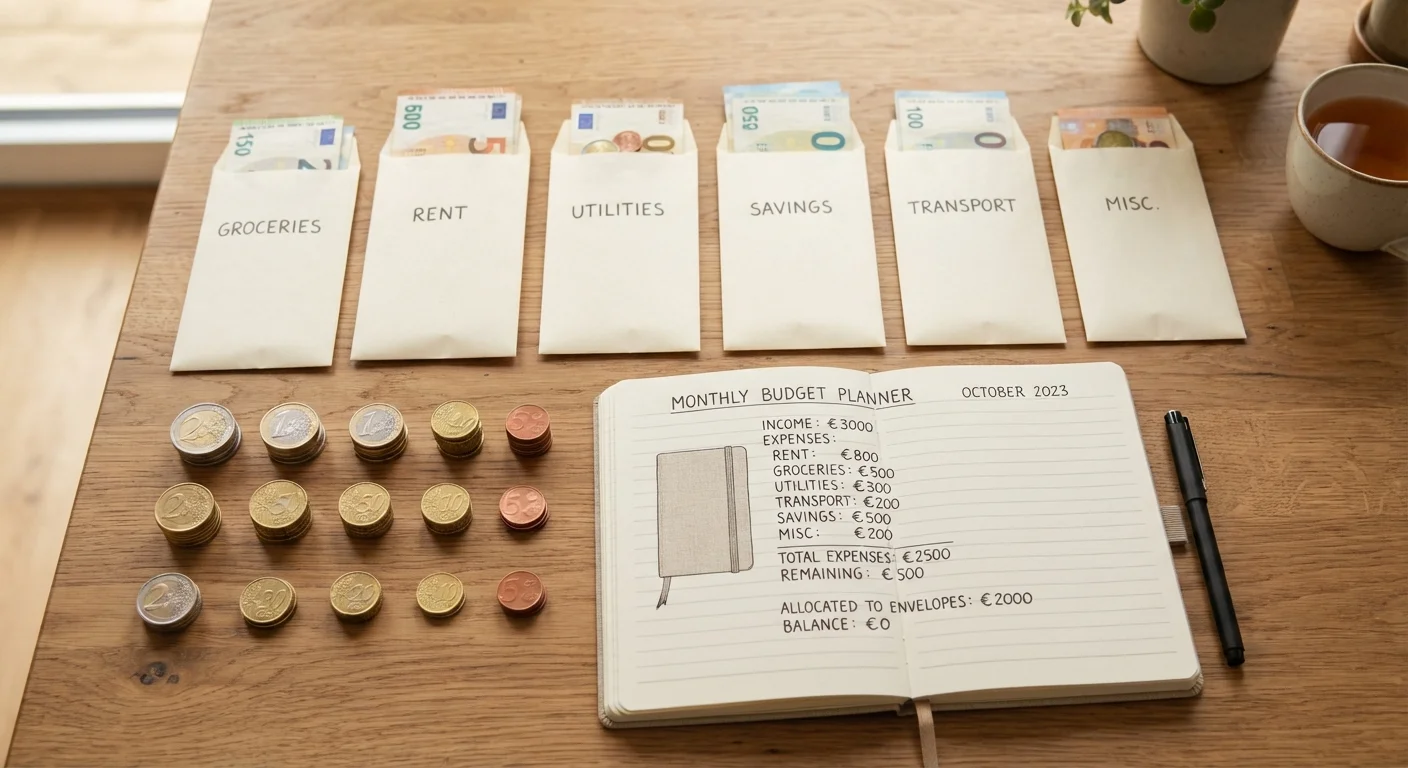
Option A
Zero-Based Budgeting
The meticulous, dollar-by-dollar planning method.
Best for: People who want full control over every dollar they earn each month, including savings and debt payments.
Option B
Envelope Budgeting
The hands-on, cash-in-hand spending system.
Best for: People who overspend in specific categories and want a physical or visual boundary to stop them.
How Each Method Actually Works
Zero-based budgeting (ZBB) starts with your monthly income and works downward. Every dollar gets a job — groceries, rent, car payment, savings, emergency fund contribution — until your income minus your assigned categories equals zero. You're not spending everything; you're planning everything. That includes money going into savings, which is treated the same as any other expense.
Envelope budgeting works differently. You divide your spending money into categories and put a set amount into each "envelope" — traditionally physical envelopes filled with cash. Groceries might get $400, dining out $150, gas $120, and so on. When the cash in an envelope runs out, spending in that category is done for the month. Many people today use digital apps that replicate this approach without physical cash.
For a deeper look at the zero-based approach on its own, see our guide to zero-based budgeting. If you're curious how envelopes stack up against another common method, envelope budgeting vs. spreadsheet budgeting walks through that comparison.
| Criterion | Zero-Based Budgeting | Envelope Budgeting |
|---|---|---|
| Core principle | Every dollar assigned a purpose | Spending capped per category |
| Scope | Full income picture — savings, debt, bills, spending | Primarily variable spending categories |
| Format | Spreadsheet, app, or paper | Physical cash or digital envelope apps |
| Setup effort | Moderate — requires line-item planning | Low to moderate — set limits per envelope |
| Works well without cash? | Yes | Yes, with a digital app |
| Handles irregular income? | Yes, with adjustment each month | Less naturally — limits assume stable amounts |
| Best strength | Total financial intentionality | Hard stop on impulse overspending |
Where They Overlap — and Where They Diverge
Both methods are proactive. Unlike simply reviewing what you spent last month, each requires you to decide in advance where money goes. That intentionality is exactly what makes both of them more effective than no system at all.
The key difference is scope. Zero-based budgeting is a whole-picture plan — income, savings, debt, irregular expenses, all of it. Envelope budgeting is primarily a spending-control tool. It excels at reining in variable spending categories but doesn't naturally prompt you to plan your savings contributions or insurance premiums.
You Don't Have to Pick Just One
Zero-based and envelope budgeting aren't mutually exclusive. Many people use ZBB to set their monthly plan — allocating income across savings, fixed bills, and spending categories — and then apply envelope-style limits within the discretionary categories. This hybrid approach captures the whole-picture discipline of ZBB and the in-the-moment control of envelopes. If one method alone hasn't clicked for you, a hybrid may be worth trying.
Some households combine both: they use zero-based planning at the start of the month to allocate income across all categories, then use envelope-style limits within the discretionary spending buckets. There's nothing wrong with borrowing the strengths of each approach. What matters is whether the system reflects your actual income and keeps your spending decisions deliberate.
For more on how different tracking systems compare, see our manual vs. app-based budgeting comparison.
Choosing Based on Your Situation
Neither method is universally superior. The right fit depends on where your money problems actually live.
If you frequently wonder where your money went at the end of the month, zero-based budgeting tends to surface the answer because it forces you to plan every dollar before it's spent. It's particularly useful if you have variable income or are actively working toward a goal like building an emergency fund or paying down debt.
If your overall income-to-expense picture is fine but you chronically overspend at the grocery store, on takeout, or at the gas station, envelope budgeting targets exactly that behavior. The psychological friction of handing over cash — or watching a digital envelope drain — is a real deterrent that abstract budget categories often aren't.
It also helps to be honest about your habits. If you rarely carry cash and pay everything digitally, a physical envelope system adds friction that may cause you to abandon it. Digital envelope apps reduce that friction significantly. On the other hand, if you find spreadsheets tedious, a pure zero-based system may stall out quickly.
Whatever method you choose, a regular review keeps it working. Our monthly budget audit checklist is a practical tool for catching drift before it becomes a real problem. And if you've been putting off budgeting because it feels too restrictive, it's worth reading through common budgeting myths first.
This article is for general informational purposes only and does not constitute personalized financial advice. Consider speaking with a licensed financial professional about your specific situation.
The content on this site is for informational purposes only and is not a substitute for professional advice. Always consult a qualified professional for guidance specific to your situation.