

Why Multi-Cat Harmony Is a Setup Problem, Not a Personality Problem
When cats in the same home fight, hide, or spray, many owners assume the animals simply don't like each other. In most cases, the real issue is environmental: not enough resources, not enough space, or introductions that moved too fast. Cats are semi-solitary by nature, meaning they haven't evolved with strong instincts for sharing territory the way dogs have. Understanding that baseline makes managing a multi-cat home a solvable problem.
The good news is that most cats can coexist — and many form genuine bonds — when their environment is set up to reduce competition. The practices below give you a framework built on feline behavioral science, not guesswork.
Core Practices for a Peaceful Multi-Cat Home
These are the foundational habits that animal behavior experts and veterinary professionals consistently recommend for households with two or more cats.
Follow the N+1 litter box rule — always provide one more box than the number of cats.
Shared or insufficient litter boxes are a primary driver of elimination problems and territorial conflict. When a dominant cat guards a box, subordinate cats are left without acceptable options, leading to stress and inappropriate elimination.
Feed cats at separate stations, ideally in different rooms or on different levels.
Mealtime is a high-stakes event for cats. Forced proximity during feeding triggers guarding behavior and creates negative associations between cats that can spill over into other interactions throughout the day.
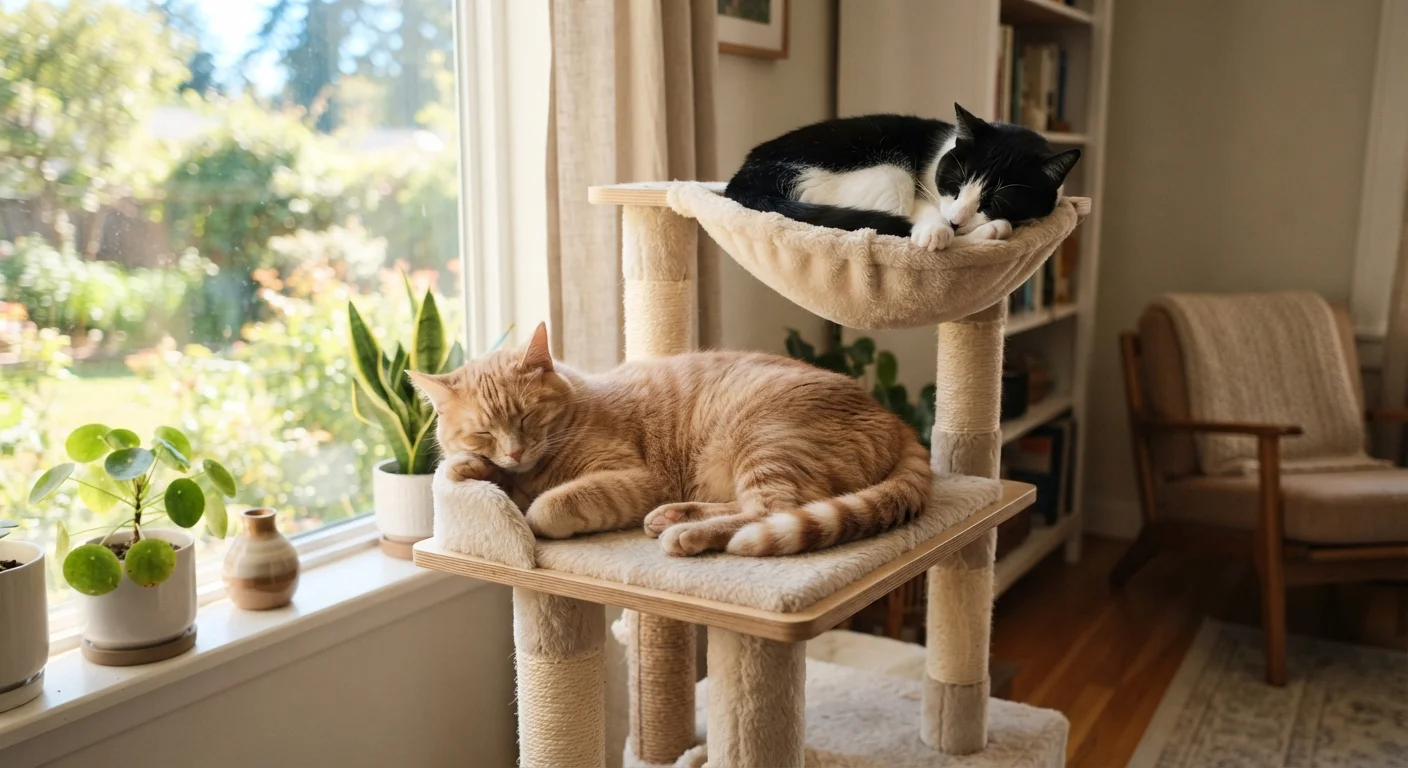
Add vertical space to multiply usable territory without expanding floor space.
Cats assess territory in three dimensions. Floor space alone is a poor measure of how much room cats feel they have. Wall-mounted shelves and multi-level cat trees allow each cat to establish a preferred elevation, reducing direct conflict.
Provide multiple hiding spots and escape routes in every shared room.
A cat that cannot retreat from a stressor — whether that's a housemate or a loud noise — becomes chronically stressed. Escape routes and covered resting spots allow lower-ranking cats to move through the home without feeling trapped.
Conduct structured, gradual introductions over one to four weeks rather than letting cats 'figure it out.'
The feline olfactory system is central to how cats assess safety. Allowing scent exchange before visual contact significantly lowers the threat level when cats finally see each other, leading to calmer first encounters.
For guidance on setting up litter boxes that cats will reliably accept, see our detailed article on litter box setup.
Quick Wins You Can Implement Today
Not every improvement requires planning weeks in advance. These actions can meaningfully reduce tension right away.
Introducing a New Cat Without Derailing the Household
The single biggest predictor of long-term success in a multi-cat home is how the initial introduction is handled. A rushed introduction can create lasting hostility between cats who might otherwise get along fine.
What 'Gradual' Actually Means
A slow introduction is measured in days and weeks, not hours. Many owners feel pressure to speed the process up when cats seem curious at the door, but curiosity and readiness for direct contact are different things. Stick to the sequence — scent first, visual second, supervised contact third — even when it feels slow. Skipping steps is the most common reason introductions fail.
The recommended approach is a gradual, scent-first introduction. Keep the new cat in a separate room with their own food, water, and litter box for at least one to two weeks. Let the cats sniff each other under the door. Swap bedding between cats so they grow accustomed to each other's scent without a face-to-face encounter. Visual introductions — such as through a cracked door or baby gate — come next, only when neither cat is showing defensive or aggressive body language.
If you're thinking ahead and haven't yet brought a second cat home, our article on adopting versus buying a cat covers how temperament and history can affect compatibility.
Recognizing Stress and Knowing When to Get Help
Some tension during adjustment periods is normal. Persistent stress, however, shows up in recognizable ways: over-grooming, hiding, changes in appetite, inappropriate elimination outside the litter box, or escalating physical fights. These are signals worth taking seriously.
Track Changes, Don't Just Observe Them
It can be easy to normalize gradual changes in a cat's behavior over weeks or months. Keeping brief notes — even just a few words on your phone — about eating, elimination, and activity levels for each cat helps you spot patterns that are easy to miss in the moment. This record is also useful when talking to your vet.
If your cats are showing ongoing behavioral changes, a veterinary visit is a practical first step — not a last resort. Some aggression and anxiety have medical components, and a vet can also refer you to a board-certified veterinary behaviorist when needed. Our guide on routine vet visits for cats explains what to bring up at appointments. Older cats in the household may need additional accommodations; see senior cat care for age-related considerations.
This article provides general information for educational purposes only and is not a substitute for professional veterinary advice. Always consult a licensed veterinarian regarding your cats' specific health or behavioral concerns.
The content on this site is for informational purposes only and is not a substitute for professional advice. Always consult a qualified professional for guidance specific to your situation.